
Back to Articles
Peak-Season Surge Pushes Freight Rates Higher Across Modes

Share
Link Copied

Link Copied

Peak season is pulling U.S. import volumes higher, and nearly every mode is getting more expensive to move freight on right now, mostly for reasons that have nothing to do with stronger demand. Ocean rates on the Asia-U.S. lanes just hit a new high for the year. Trucking capacity keeps shrinking as federal enforcement removes drivers from the road faster than fleets can replace them. And a trade court just closed the door on reviving one of the few remaining ways to move goods into the country cheaply.
U.S. Container Imports Surge on China Peak-Season Momentum
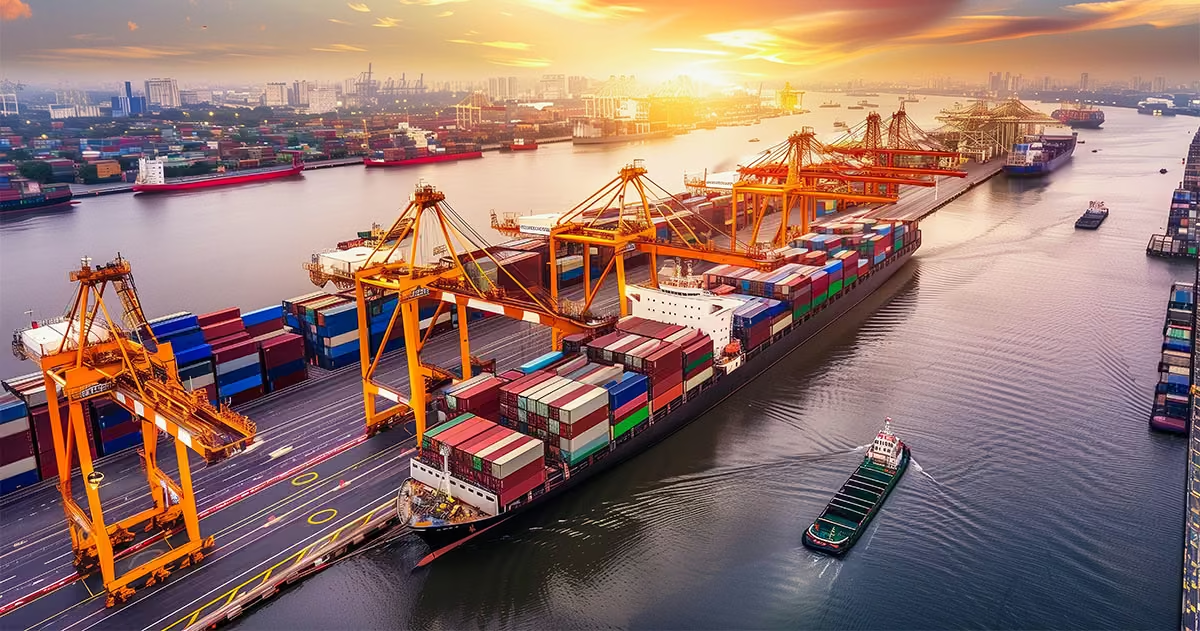
U.S. containerized imports rose 4.5% in July from June to 2.51 million TEUs, according to Descartes Systems Group’s July Global Shipping Report, a seasonal gain consistent with the pattern seen every July for the past decade. China led the increase, up 7.2% to its highest monthly level since July 2025, with broad gains across other major Asian and European origin markets. Total imports still trailed July 2025 by 4.3%, a difficult comparison against last year’s heavy tariff-driven front-loading. As we noted in an earlier look at this year’s early peak season, retailers pulling inventory forward keeps reshaping how this peak plays out.
Asia-U.S. East Coast Box Rate Hits New High of $9,400
Asia-U.S. East Coast container rates reached $9,400 per forty-foot equivalent unit this week, up from $9,000 in early July, while West Coast rates climbed to about $7,400, according to Freightos Baltic Index data. Freightos analyst Judah Levine attributed the strength to shippers that had held back on peak season orders now increasing shipments as consumers keep spending despite inflation. The National Retail Federation revised its outlook accordingly, now expecting elevated import demand through September instead of the sharp drop it had projected, echoing the rate volatility we flagged when Asia-U.S. rates first surged this summer.
Is the Truck Driver Shortage Back?
U.S. truck freight capacity tightened sharply in the second quarter, and the cause is regulatory, not economic: national freight shipments fell 2.8% year over year even as shipper spending jumped 28.1%. The carrier population lost a net 50,000 prospects over the past year as enforcement placed roughly 27,000 drivers out of service under English proficiency rules and moved to disqualify most non-domiciled CDL holders. Schneider National’s Jim Filter called the market driver-constrained rather than short, expecting the recovery to stretch longer than past cycles as spot rates jumped 18.9% quarter over quarter to $3.02 per mile. It is the same driver squeeze we covered when trucking jobs stalled earlier this year.
U.S. De Minimis Elimination Upheld by Trade Court
The U.S. Court of International Trade upheld the Trump administration’s elimination of the de minimis exemption, which had let imports under $800 enter duty free, rejecting a challenge from auto parts importer Detroit Axle that the move exceeded presidential authority under IEEPA. The panel found that rescinding an exemption is not the same as imposing a new tariff. Detroit Axle said the change subjects its China-sourced parts to a 52.5% tariff. Even a win would have been temporary: legislation already on the books ends de minimis in July 2027 regardless.
Truckload Linehaul Rates Rip Higher in July, Cass Says
Cass Information Systems’ Truckload Linehaul Index rose 2.3% from June and 8.6% year over year in July, its largest annual gain in four years despite shipment volumes falling 4.8% year over year. Carriers described a flight to quality this earnings season, with shippers growing more selective given the legal and capacity risk of a non-compliant fleet. Werner’s Derek Leathers said he remains unfazed by the July slowdown and is guiding to a 10% to 13% year-over-year increase in rate per mile for the third quarter.
Ship Seamlessly With APL Logistics
Every story this week points to the same dynamic: freight costs are climbing because of capacity, compliance, and trade policy risk, not because shippers are moving more freight. That makes it harder to manage on your own. APL Logistics’ transportation network is built to absorb the kind of driver and capacity swings reshaping truckload pricing, while our customs brokerage and global trade team keeps import programs compliant as courts and regulators redraw the rules on tariffs and de minimis. For shippers riding out this peak season, distribution and fulfillment gives you warehouse capacity that flexes with the import surge instead of fighting it.
Shipping internationally means coordinating freight, customs, warehousing, and last-mile delivery, often with different providers who don’t communicate with each other. With operations in more than 60 countries and over 200 facilities, APL Logistics brings it all under one roof. This way, you won’t chase updates across four different vendors or find out about problems after the fact. Contact us today to get started.
Back to Articles
Updates
Subscribe to The Pulse Newsletter
Get in Touch
Whether you have a question, need support, or want to learn more about our logistics solutions, fill out the form below and our team will get back to you as soon as possible.
We'll be in touch soon.

Your Partner for Connected, Integrated Solutions
APLL works with enterprises that manage complex supply chains, delivering custom solutions and reliable execution.