Back to Articles
Predictability: The Value in Definite-Day Delivery
Share
Link Copied

Link Copied

For decades, supply chains optimized primarily for transportation costs. Today, leaders are discovering that uncertainty itself has become one of the largest cost drivers.
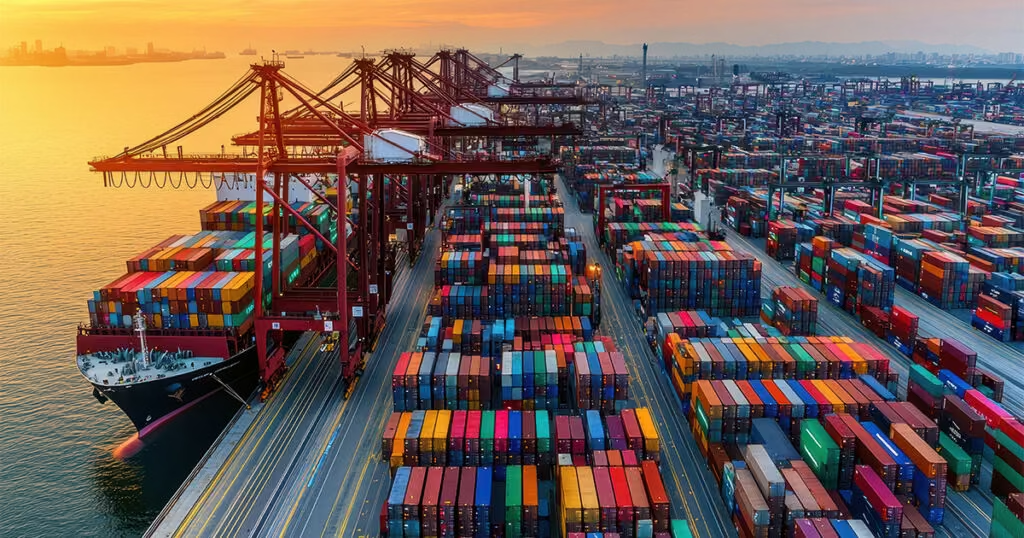
For supply chain leadership, the world has changed. They now face a supply chain landscape in which global trade lane stability can fluctuate and where freight interruptions are more common than ever before. Port congestion, tariff uncertainty, shifting consumer demand, and geopolitical tensions have all altered the very meaning of a successful supply chain.
Businesses that are still building inventory strategies and supply chain decisions around the idea of relatively consistent transit times that no longer exist are inadvertently weakening their own resilience. Variability is now the norm. In an environment like this, companies often discover that the true cost of uncertain transportation dates is not always found on their freight invoices.
Rather, it’s found in the cost of that uncertainty.
This article examine predictability through the supply chain lens, and how companies can improve their resilience and stability through definite-day delivery options and other approaches. It is informed by insights shared by Carmine Santo, Chief of Staff at APL Logistics.
The Hidden Costs of Variability
A single late shipment israrely a crisis, and the immediate impact is often manageable, if not ideal. However, when a pattern of missed delivery dates and late delivery timelinesemerges, the downstream consequences can be impactful indeed.
Delayed shipments cantrigger extensive internal responses, such as emergency planning meetings andtime spent seeking alternative solutions or trying to juggle shipments to covergaps. Inevitably, expedited transportation expenses have to be accounted for.
This impact then ripplesthrough the company, raising overtime and labor costs and needing adaptation toinventory shortages and production disruptions. Everyone from supply chainleadership and procurement teams to warehouse operations, transportation managers,and customer service teams find themselves reacting in “crisis mode.” And eachof these responses comes at a cost, whether tangible or intangible.
Unpredictability carriessignificant operational churn and keeps companies reactive instead of allowingthem to proactively build resilience into their supply chains. As Carmine Santoputs it, “the lowest transit price isn't always the cheapest in the end.”
This is why many supplychain leaders are moving away from the simpler question of how much it costs tomove a shipment to a more holistic one:
“What will it cost us ifthis shipment doesn’t arrive when we expect it to?”
Reliability Now Matters More Than Raw Speed
Reliability is now more important thansimple speed. Supply chains can adapt to known transit times, allowinginventory levels, labor schedules, replenishment plans, and customercommitments to align with predictable delivery dates, no matter when those datesmay actually be. Knowing a shipment will arrive consistently in 35 days, withlittle variation, is more valuable than predicting it might arrive in21, but could take 40.
This predictability is the foundationof planning, and planning is what creates efficiency and stability. Reliabletransportation windows are now more than a logistics function. They’re abusiness enabler.
From Cost Optimization to Resilient Supply Chain Design
For decades, cost optimization was the major driver behind decision-making. Since the pandemic and accompanying global disruptions, the focus has shifted to designing a resilient, integrated network. We’re now seeing more thoughtful design in the supply chain, with layers specifically created to offer greater stability, not necessarily greater cost reduction. While budgets will, of course, always matter, predictability is now of equal importance.
There’s also a shift away from another outdated binary: sea vs. air alone. The reality is not every shipment needs air freight, and not every shipment can tolerate the variability inherent in traditional ocean freight solutions. Instead, service levels should be defined by the needs of the product or product segment and the customer commitments behind them. This allows companies to better align their transportation decisions with real business priorities, instead of treating them as a one-size-fits-all.
This approach also introduces more flexibility, which is essential as the supply chain environment and broader market becomes both more complex and volatile.
Turning Predictability into a Competitive Advantage
Resilience, reliability, and the ability to keep to customer commitments even during disruption are now essential within supply chains. Businesses will always need to balance cost,speed, and service. But the companies that design and interconnect their supplychain for all contingencies, with a focus on risk reduction, movepredictability from a transportation metric into a business capability.
Freight services that offer definite-day or definite-window arrivals often correlate with logistics partners who have control not just over their ports of origin, but also the corresponding terminal operations and other downstream factors. This degree of operational control improves predictability across the whole delivery chain, not just at departure. As Santo stated,“ Just because your goods are in motion doesn’t mean they’re any closer to being in your customer’s hands.”
This is one of the key benefits of APL Logistics’ own day-definite service, OceanGuaranteed™, where the delivery promise is not to the port-side, but rather to the final destination, with first-off-the-ship priority as part of the package. This alleviates some of the operational complexities that introduce disruptions that affect predictability for our partner companies. It also offers a cost-effective, reliable contingency solution that bridges the gap between expensive emergency air freight and standard shipping choices, even for less-than-container-load and partial shipments.
Definite-day solutions play an important part in this mindset shift, bridging the gap between traditional ocean freight and air freight alternatives. The introduction of these extra options for specific parts of the supply chain breaks free of the sea/air binary, offering both flexibility and added predictability. Goods that cannot tolerate variability can be prioritized, while traditional methods remain in place where appropriate.
More importantly, these solutions bring back something that has been missing in the modern supply chain environment: certainty. In an increasingly uncertain world, that certainty has a hard dollar value that smart supply chain leaders can no longer ignore.
APL Logistics can support you with services ranging from individual freight solutions to full-service order management. If you’re looking to increase predictability across your supply chain, reach out to our team.
Back to Articles
Updates
Subscribe to The Pulse Newsletter
Get in Touch
Whether you have a question, need support, or want to learn more about our logistics solutions, fill out the form below and our team will get back to you as soon as possible.
We'll be in touch soon.



.avif)
.avif)
.avif)

.avif)
.avif)























Your Partner for Connected, Integrated Solutions
APLL works with enterprises that manage complex supply chains, delivering custom solutions and reliable execution.